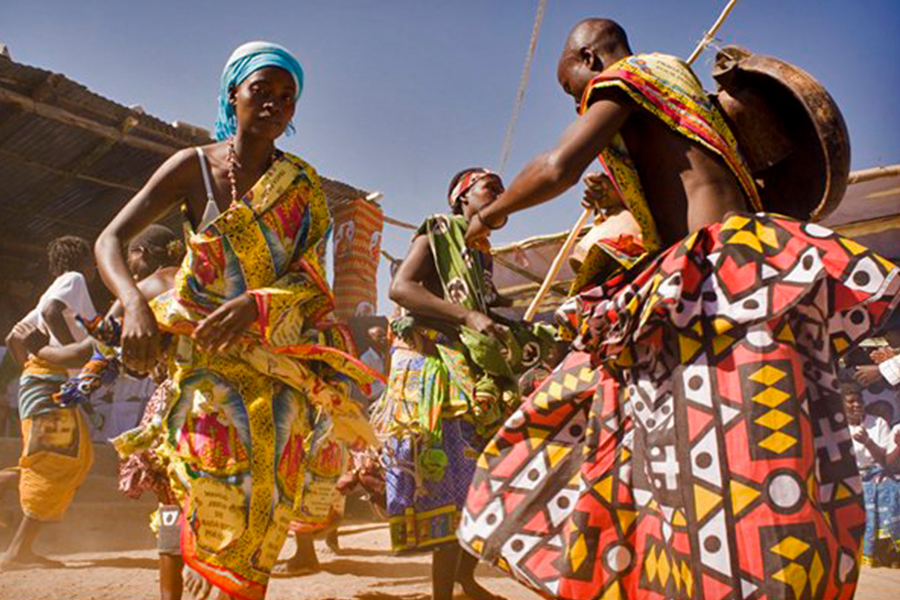
Culture in Angola
Precolonial culture in Angola was broadly similar from one end of the country to another, albeit with local variations and some differences stemming from the many, though mostly related, languages spoken in the area. A common traditional culture is still noticeable in Angola.
Portuguese contact beginning in the late 15th century produced an overlay of European culture that was accepted to varying degrees in much of the northwestern part of the country. The Portuguese settled at Luanda in 1575 and established the core of colonial Angola in the area approximately 90 miles (150 km) inland from Luanda. By the mid-17th century a mixture of Mbundu and Portuguese culture had emerged in the region, and in 18th-century Luanda, Kimbundu (the language of the Mbundu) predominated as the language of the elite; even Portuguese of considerable stature who resided locally spoke Kimbundu, often in preference to Portuguese.
In the 19th century the Luanda elite embraced both Kimbundu and Portuguese culture and language and valued their blended nature, and the eventual cessation of Kimbundu as the language of the elite did not occur until after 1910. In contrast, a class of mixed origin (including government officials, the assimilated African and mulatto population, and, later, the settlers that moved to the country after 1945) that was strongly Portuguese in language and cultural expression developed after 1850 with the Portuguese conquest of the rest of Angola and with the programs of assimilation that were begun in 1910 and intensified after 1926.
This predominantly Portuguese culture coexisted with a less-assimilated rural population that harkened back to the mixed culture of earlier times (especially in the Kongo areas) or to the traditional cultures (in those regions brought under Portuguese control after 1850). Protestant missionaries introduced North American and British influences; they were anxious to promote significant cultural change—including the introduction of many Western norms under the guise of modernization—as well as religious conversion, although they preferred to teach in indigenous languages.
After independence the propaganda of the emerging nationalist movements placed a greater value on the purely African culture, but, because of the colonial policy of assimilation, most educated Angolans were more Portuguese than African in their general cultural orientation.
This created considerable cultural conflict and had political implications as well, because those who were assimilated were generally the educational and political leaders. Although rigorous censorship ceased in the 1990s, both the cultural ambiguity of many in the government and the desire to discourage the “tribalism” that endured initially made Angola, in spite of official positions, less supportive of cultural expressions that were not Portuguese based.
However, this began to change in the first decade of the 21st century, as the government appeared to be somewhat more accommodating.