 Angola History
Official Name
Republic of Angola.
Date of Independence
11 November 1975, after a long struggle against Portuguese colonial rule.
System of Government
Presidential. The President of the Republic is both Head of State and Head of Government.
Current President: João Manuel Gonçalves Lourenço.
Vice-President: Esperança Maria Eduardo da Costa.
National Assembly: (unicameral) as the legislative body.
Constitution: Currently in force, promulgated on 5 February 2010.
Sovereign bodies:
-
President of the Republic
-
National Assembly
-
The Courts
National Symbols
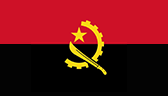
Flag: Two horizontal bands – red (upper half) and black (lower half).
In the centre: a cogwheel, a machete and a star, all in yellow.
Red symbolises the blood shed by nationalists; black symbolises the African continent.
National Insignia / Coat of Arms: The insignia (“emblem”) includes a cogwheel, maize, coffee and cotton branches, symbols of industrial and agricultural labour; an open book (education), rising sun (new country), machete and hoe (struggle and work), and a golden star (progress and solidarity).
National Anthem: “Angola Avante”
It was adopted on 11 November 1975, with lyrics by Manuel Rui Alves Monteiro and music by Rui Alberto Vieira Dias Mingas.
Music: Kizomba, Kuduro, Semba.
History: Queen Njinga Mbandi, a prominent figure of resistance against colonisation.
Gastronomy: Funje (made from cassava flour) as a staple dish.
Territory and Administrative Division
Area: Approximately 1,246,700 km².
Provinces: Angola is divided into 21 provinces.
They are: Bengo; Benguela; Bié; Cabinda; Cuando; Cuanza Norte; Cuanza Sul; Cubango; Cunene; Icolo e Bengo; Huambo; Huíla; Luanda; Lunda Norte; Lunda Sul; Malanje; Moxico; Moxico Leste; Namibe; Uíge; Zaire.
Municipalities: 326
Communes: 378
Capital: Luanda.
Geography and Nature
Location: Southern Africa, bordered by the Atlantic, the DRC, Zambia and Namibia.
Main rivers: Kwanza, Cunene, Zambezi (section).
Geographical features: Serra da Leba, Morro do Moco (highest point at 2,620 m).
Climate: Tropical, with savannah, semi-arid and humid variations.
Natural resources: Oil, diamonds, iron, gas, fresh water.
National currency: Kwanza, named after Angola’s largest river, the Kwanza River.
Population: Estimated at 39 million.
Red Acacia: A natural beauty of Benguela.